Somewhere between the school runs, the long commutes down Van Dyke Avenue, and the Saturday afternoons at Freedom Hill, most of us stop noticing the gradual changes happening to our faces. A little hollowing around the cheeks. A lower lip that doesn’t sit quite right. Lines that seem to have appeared from nowhere. We chalk it up to age, maybe change our moisturizer, and move on. But here’s something that rarely gets mentioned in conversations about aging: a great deal of what makes a face look older isn’t about skin at all — it’s about what’s happening inside the mouth.
Tooth volume. Tooth position. The structural support your teeth provide to the lower third of your face. These factors are so foundational to how old or young you look that working with a skilled cosmetic dentist in Center Line to restore them can produce a visible, natural transformation — no injections, no surgical recovery.
The Connection Between Teeth and Facial Structure
Think of your teeth as the scaffolding of your lower face. When that scaffolding is intact, properly proportioned, and fully erupted, holding the lips and cheeks in their natural position — your face has a certain fullness and balance. When teeth wear down, shift, or are lost, that support system erodes with them.
The changes are subtle at first. Worn molars can reduce the vertical dimension of the face — the measured distance between the chin and the nose when the mouth is relaxed. As that dimension collapses, even slightly, the lower face begins to look compressed. Lips thin. The corners of the mouth turn downward. Cheeks lose their forward projection. These are the changes that make people look tired or older than they feel, and they often have far more to do with dental structure than with skin aging.
This is not a fringe theory. It’s a principle that restorative and cosmetic dentistry has built entire treatment philosophies around, and it’s one that Dr. Richard Schwarcz and Dr. Ami Schwarcz at Comfort Family Dental understand well. The face and the bite are not separate conversations.
What ‘Restoring Tooth Volume’ Actually Means
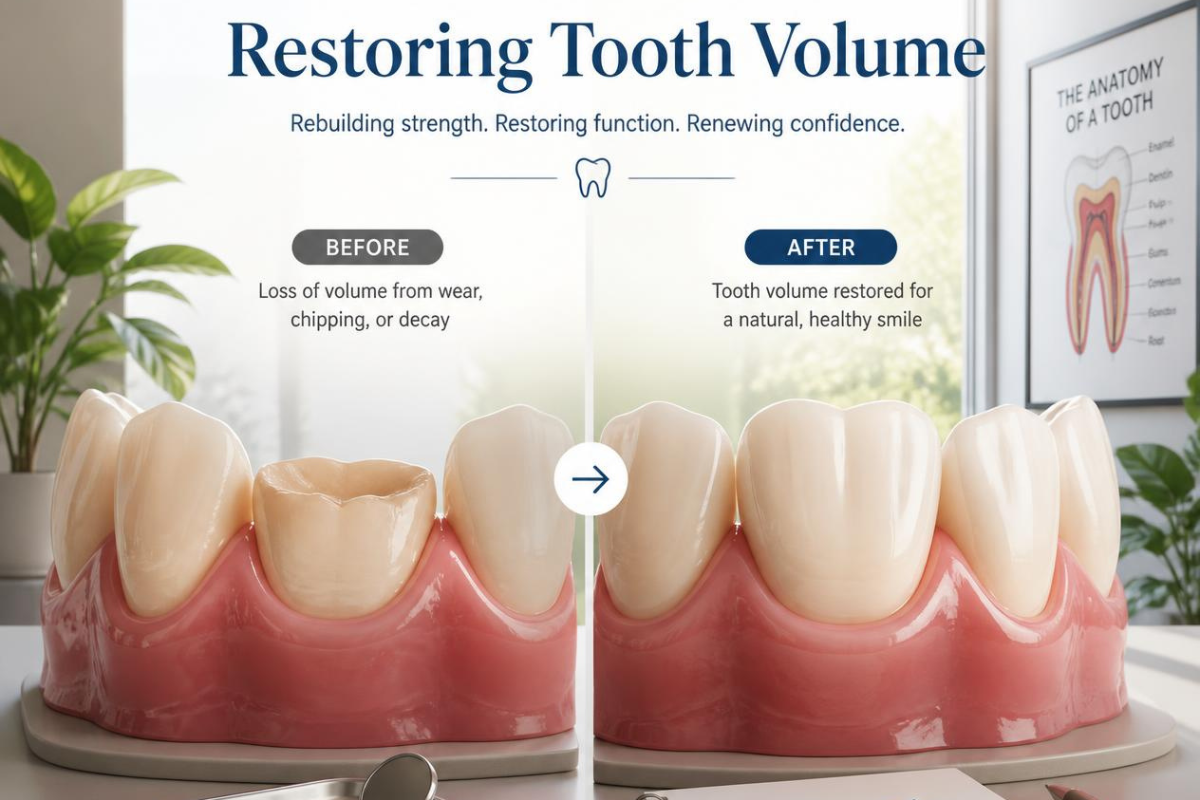
The phrase sounds technical, but the idea is straightforward. Restoring tooth volume means bringing teeth back to their natural size, shape, and height — the dimensions they had before years of wear, decay, or loss took their toll.
This can involve:
- Dental crowns — full-coverage restorations that rebuild the size and shape of worn or damaged back teeth, restoring the proper bite height.
- Porcelain veneers — thin shells bonded to the front surfaces of teeth to restore their length, correct their shape, and close gaps that have widened with time.
- Composite bonding — direct sculpting of tooth-colored material onto worn or chipped surfaces, a surprisingly fast and affordable way to restore contour.
- Dental implants or implant-supported bridges — replacing missing teeth that have allowed neighboring teeth to drift and bite height to collapse.
- Full-mouth rehabilitation — a coordinated approach combining multiple treatments to systematically rebuild the entire bite to its correct function and dimension.
The result of these treatments, when done with an eye toward facial harmony, is that the lower face regains its structural foundation. Lips appear fuller because they’re supported properly. Cheeks look less hollow. That downward pull at the corners of the mouth eases. Patients often describe looking as though they’ve had something done — but nobody can quite put their finger on what.
Why This Matters for Center Line Patients Specifically
The greater Detroit area has one of the most hardworking populations in the country, and that work — years of stress, coffee, clenching during long shifts, and the kind of wear that comes with decades of life in a post-industrial city — shows up in teeth. Bruxism (teeth grinding) is particularly prevalent in stressed, sleep-deprived adults, and it silently erodes tooth height over years and decades. Many patients from Center Line, Warren, and the surrounding communities don’t realize how much vertical height they’ve lost until they see photographs side by side or a dentist points it out on an X-ray.
The good news is that this kind of wear is absolutely treatable. It’s not irreversible. And the aesthetic benefits of treating it extend well beyond the mouth.
What to Expect From a Restorative Smile Consultation
A consultation at Comfort Family Dental begins with a comprehensive evaluation — photographs, bite analysis, X-rays, and a conversation about what you’re noticing and what you’d like to change. Dr. Schwarcz will identify the extent of any tooth wear, the effect it’s having on your bite and facial proportions, and the treatments most likely to produce the outcome you’re looking for.
For some patients, the answer is a few well-placed veneers or crowns. For others, a full-mouth approach is the better path. Either way, the planning is methodical, the timeline is realistic, and the goal is always the same: a result that looks completely natural and functions properly for the long term.
If you’re in Center Line, Warren, Detroit, or anywhere in Macomb County and have noticed changes in your face you can’t quite explain, it may be worth having your dental structure evaluated. As a trusted cosmetic dentist in Center Line, the team at Comfort Family Dental can tell you quickly whether dental restoration is part of the answer.
Key Takeaways
- Tooth wear and tooth loss reduce the vertical support of the lower face, contributing to an older appearance.
- Restoring proper tooth volume can reverse this structural collapse without surgery.
- Crowns, veneers, bonding, and implants all play a role depending on the extent of wear or loss.
- Results look natural because they’re rebuilding what was naturally there.
- Grinding (bruxism) is a major cause of tooth volume loss and is very common in stressed adults.
- A comprehensive evaluation is the starting point — no commitment required to consult.
Frequently Asked Questions
Q: Will this actually make me look younger, or is that an exaggeration?
It’s not an exaggeration, though results vary. Patients with significant tooth wear or loss often see a meaningful change in facial fullness and the position of the lips after restoring bite height. It’s not a face-lift in the surgical sense, but the structural support it restores can produce a genuinely rejuvenating effect that patients — and people who know them — notice.
Q: How do I know if I’ve lost tooth height from grinding?
Common signs include teeth that look shorter or flatter than they used to, sensitivity to temperature, worn or flattened biting edges, jaw soreness in the morning, and headaches. A dental exam will confirm whether grinding-related wear is present and how much height has been lost.
Q: Is full-mouth rehabilitation painful?
Modern dental techniques and anesthesia make the process much more comfortable than most patients expect. Staged treatment plans spread the work across multiple appointments, so recovery is manageable at each step. Most patients are surprised by how little discomfort they experience.
Q: How long does restorative dental work last?
Porcelain crowns and veneers typically last 10 to 20 years with proper care. Dental implants can last a lifetime. Composite bonding has a shorter lifespan — around five to eight years — but is repairable and refinishable. Your dentist will give you realistic longevity estimates for any recommended treatment.
Q: Can this be done if I have other dental health issues?
Generally, yes — but dental health problems like active gum disease or untreated decay are usually addressed first. A healthy foundation is essential for cosmetic and restorative work to look its best and last as long as possible. Your consultation will map out the right sequence for your specific situation.
Q: Does dental insurance cover any of this?
Treatments that address structural or functional issues — like crowns for severely worn teeth or implants for missing teeth — may receive partial insurance coverage, since they’re not purely cosmetic. Purely aesthetic treatments like veneers typically are not covered. The team at Comfort Family Dental will review your benefits and clarify coverage before any treatment plan is finalized.
Ready to see what restoring your smile could do for your face? Schedule a comprehensive consultation with Dr. Richard Schwarcz or Dr. Ami Schwarcz at Comfort Family Dental — serving patients in Center Line, Warren, Detroit, and throughout Macomb County. Book your appointment at +1-5869806011.
**Disclaimer: This content should not be considered medical advice and does not imply a doctor-patient relationship.