

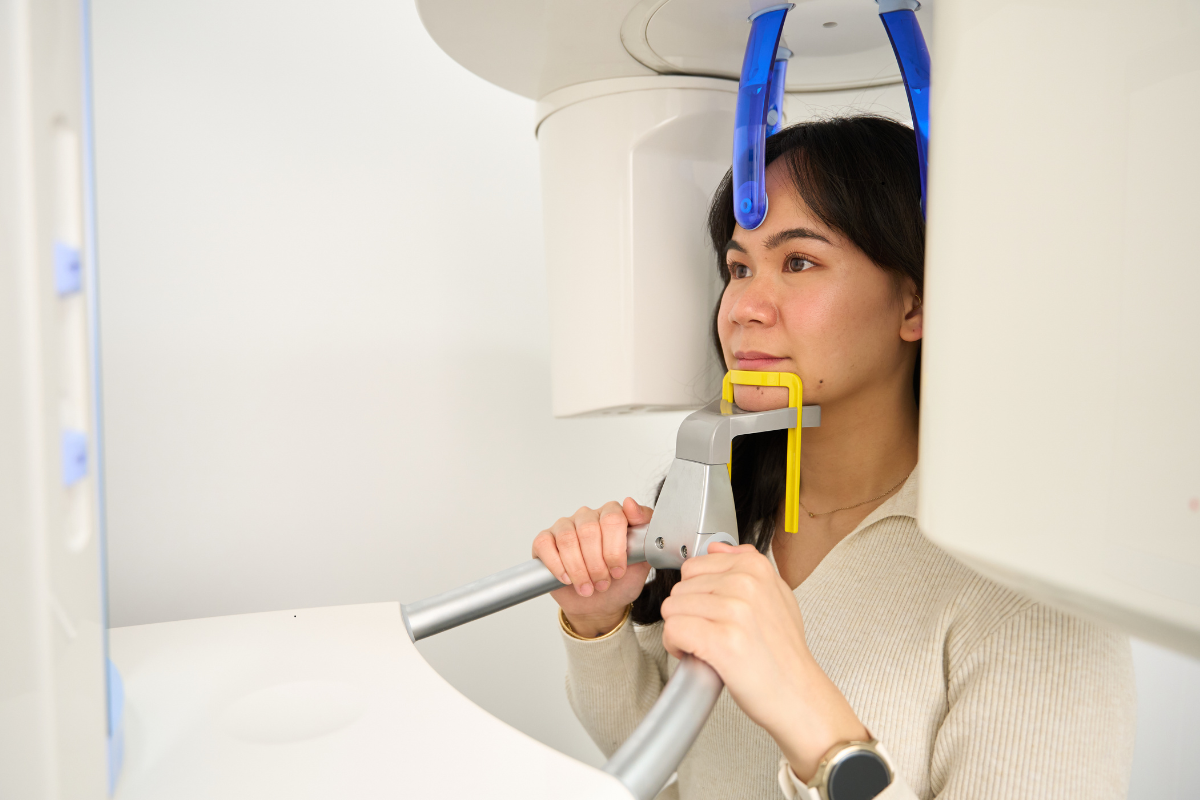
If you’ve ever been told you need a root canal, you know the mix of anxiety and questions that follows. Will it hurt? How long will it take? Will it actually fix the problem? The good news is that modern dentistry has come a long way — and one technology is quietly rewriting what’s possible in endodontic care. CBCT (Cone Beam Computed Tomography) imaging is a three-dimensional scanning tool that gives dental professionals a level of detail that a traditional X-ray simply cannot match. For patients working with an endodontist in Center Line, this technology can be the difference between a treatment that works long-term and one that misses something critical.
What Exactly Is CBCT Imaging?
CBCT stands for Cone Beam Computed Tomography. Unlike a standard dental X-ray that produces a flat, two-dimensional image, CBCT creates a full three-dimensional model of your teeth, roots, surrounding bone, and soft tissue — all in a single scan that takes under a minute.
The scan uses a cone-shaped beam of X-rays that rotates around your head, capturing hundreds of individual images that are then reconstructed into a 3D model a dentist can rotate, zoom in on, and examine from every angle. The radiation exposure is significantly lower than a medical CT scan, making it a practical tool for everyday clinical use.
Why Does This Matter for Root Canal Treatment?
Root canals fail for a handful of predictable reasons — and nearly all of them come down to incomplete information at the diagnosis stage. Here’s what CBCT changes:
- Hidden canals: Some teeth have extra root canals that don’t show up on a 2D X-ray. CBCT reveals these so they can be properly cleaned and sealed.
- Curved or complex root anatomy: Roots aren’t always straight. A three-dimensional view helps the dentist navigate curves without perforating the root.
- Bone loss and infection spread: CBCT shows exactly how far an infection has traveled into surrounding bone — critical for treatment planning.
- Fractures: Vertical root fractures are notoriously hard to spot on standard X-rays. CBCT can detect them early, potentially saving a tooth.
- Proximity to nerves and sinuses: For upper back teeth especially, root tips can sit dangerously close to the sinus cavity. CBCT maps this precisely.
Dr. Ami Schwarcz and Dr. Richard Schwarcz at Comfort Family Dental understand that accurate diagnosis isn’t a luxury — it’s the foundation of every successful outcome. Bringing this technology into their Center Line practice reflects a commitment to giving every patient the clearest possible picture before treatment begins.
CBCT Imaging and the Local Community in Center Line
Center Line is a tight-knit community tucked between Warren and Detroit on Van Dyke Avenue — a city where people value getting things done right the first time. Whether you work at one of the local manufacturing plants, run a small business on the east side of Macomb County, or simply want to avoid taking extra days off work for dental follow-ups, CBCT imaging matters because it reduces the chance of a retreatment. Fewer surprises. Fewer callbacks. More confidence going into your procedure.
What the Research Actually Shows
Multiple clinical studies have shown that CBCT imaging improves the detection of additional root canals, periapical lesions (infections at the root tip), and root fractures compared to 2D radiography. In one frequently cited analysis, CBCT identified clinically significant findings that changed the treatment plan in nearly 62% of cases where standard X-rays appeared normal or inconclusive.
That’s not a minor improvement — that’s a fundamental shift in how thoroughly endodontic problems can be understood and addressed.
Key Takeaways at a Glance
- CBCT creates a 3D model of your teeth and roots in under 60 seconds
- It reveals hidden canals, fractures, and infections that flat X-rays miss
- Lower radiation than a standard medical CT scan
- Reduces the likelihood of endodontic retreatment
- Helps dentists plan with precision instead of guessing
Frequently Asked Questions
Q: Is CBCT imaging safe?
Yes. CBCT uses a significantly lower dose of radiation than a traditional medical CT scan. For most patients, a CBCT scan exposes you to roughly the same radiation as a few digital dental X-rays taken together.
Q: Do I need CBCT imaging for every root canal?
Not necessarily. Your dentist will recommend it when the anatomy is complex, when standard X-rays aren’t giving a complete picture, or when a previous treatment has failed. It’s a tool used with purpose, not a routine protocol for every case.
Q: Will my insurance cover CBCT imaging?
Coverage varies by plan. Many dental insurances cover CBCT when it’s deemed diagnostically necessary. The team at Comfort Family Dental can help you understand your benefits before your appointment.
Q: How do I know if I need an endodontic evaluation?
Common signs include persistent tooth pain, sensitivity to hot or cold that lingers, darkening of a tooth, or swelling near the gum line. If you’re experiencing any of these in Center Line or the surrounding Macomb County area, it’s worth getting checked sooner rather than later.
Ready to get a clearer picture of your dental health?
Schedule a visit with Dr. Ami Schwarcz or Dr. Richard Schwarcz at Comfort Family Dental. Our team is here to make sure you get the accurate diagnosis and honest answers you deserve right here in Center Line. Book your appointment at mycomfortfamilydental.com.
**Disclaimer: This content should not be considered medical advice and does not imply a doctor-patient relationship.
